
Best CRM for Small Business 2026: 7 Platforms Tested and Ranked
Best CRM for small business 2026. Ranked by usability, pricing, and fit for teams under 50. Free and paid options.
A CRM should make your sales process faster and your customer data more visible. For small businesses, it should also be affordable, quick to set up, and something your team will actually use.
Seven platforms tested across pricing, ease of use, core CRM features, and fit for teams under 50.
Last tested: July 2026
What Small Businesses Actually Need from a CRM
The requirements differ by business type.
Sales-led small businesses (consultancies, agencies, B2B services) need contact management, a visual deal pipeline, email tracking, and follow-up reminders. Sophisticated automation and marketing features are secondary.
Service-heavy small businesses (local trades, healthcare, home services) need appointment scheduling, SMS communication, and reputation management alongside basic contact management.
Growth-focused small businesses scaling their sales pipeline need email sequencing, deal velocity reporting, and lead scoring as core requirements.
Different tools serve these profiles. No single CRM wins across all three.
The 7 Best CRMs for Small Business
1. HubSpot: Best Overall and Best Free CRM
Price: Free to $800+/month | Free tier: Yes
HubSpot’s free CRM is the correct starting point for most small businesses. Unlimited contacts, a visual deal pipeline, email tracking, meeting scheduling, and live chat at no cost with no time limit.
The onboarding is the best in this comparison: guided setup, contextual help, and HubSpot Academy provide structured learning for every feature. Most users are productive within a day.
The limitation to plan for: the jump from Starter ($50/month) to Professional ($800/month) is steep. Starter adds sequences and basic automation. Professional adds advanced workflow automation and custom reporting. The gap between them catches growing businesses off guard.
Best for: Most small businesses starting their first CRM or upgrading from a spreadsheet.
See our full HubSpot CRM review.
2. Pipedrive: Best for Sales-Focused Small Teams
Price: $14.90-99/user/month | Free trial: 14 days
Pipedrive is purpose-built for sales pipeline management. The visual Kanban board is clean and intuitive, deal stages are fully customisable, and the mobile app is consistently rated among the best for on-the-go updates.
The activity-based selling model is Pipedrive’s signature strength: the platform is built around completing the right calls, emails, and follow-ups to move deals forward. It enforces that discipline better than most CRMs.
Where it falls short: no native email marketing broadcasts, no SMS, no landing pages. If your business needs a marketing and sales platform in one tool, Pipedrive requires integrations to fill those gaps.
Best for: Sales-focused small teams where pipeline clarity and activity management are the primary needs.
3. Zoho CRM: Best Value for Feature-Dense Requirements
Price: Free (3 users) to $52/user/month | Free tier: Yes
Zoho CRM offers the broadest feature set per pound spent. Paid tiers include workflow automation, territory management, AI-powered lead scoring, and social media integration from $20/user/month.
The interface is the least polished in this comparison and the learning curve is steeper than HubSpot or Pipedrive. A technical team member handling configuration gets more out of Zoho than a self-implementing solo operator.
The Zoho One bundle ($37/user/month) includes 40+ Zoho apps: CRM, email marketing, accounting, helpdesk, and project management. For businesses building a Zoho ecosystem, the value is exceptional.
Best for: Feature-heavy requirements at low per-user cost, especially within the Zoho ecosystem.
4. GoHighLevel: Best for Service Businesses Replacing Multiple Tools
Price: $97-297/month | Free trial: 14 days
GoHighLevel earns its place for a specific profile: service businesses paying separately for a CRM, email tool, booking system, and reputation management. If those tools combined cost more than $100-150/month, GoHighLevel Starter almost certainly saves money while reducing tool count.
CRM, email marketing, SMS, appointment scheduling, funnel builder, and reputation management on one subscription. For local businesses in healthcare, real estate, and home services, the consolidation is compelling.
The caveat: the learning curve is the steepest on this list. Plan for 20-30 hours of setup time before your first automation runs reliably.
Best for: Service-based small businesses with appointment, SMS, and reputation management needs.
Try GoHighLevel free for 14 days
5. Monday.com CRM: Best for Visual Workflow Teams
Price: $12-24/seat/month | Free tier: Yes (2 seats)
Monday.com’s CRM module layers contact and deal management onto a visual work management platform. For small businesses already using Monday.com for project delivery, extending it to client relationship tracking keeps everything in one place.
The pipeline view is customisable but less purpose-built than Pipedrive. Email tracking and automation are less developed than HubSpot. It works best when project management and CRM overlap significantly.
Best for: Teams already on Monday.com for project management who want CRM without adding a new platform.
6. Freshsales: Best for Phone-Led Sales Teams
Price: Free to $69/user/month | Free tier: Yes
Freshsales includes a built-in phone system: outbound calling, call recording, and automatic call note logging. For small businesses where phone sales is a primary channel, the native integration removes the need for a separate calling tool.
The AI assistant (Freddy AI) provides lead scoring and next-step recommendations on paid tiers. Clean interface, well-designed onboarding, and a capable free tier make it a consistently underrated option.
Best for: Small sales teams where outbound phone calls are the primary activity.
7. Close CRM: Best for High-Volume Inside Sales
Price: $9-139/user/month | Free trial: 14 days
Close is built for inside sales teams running high-volume outreach. Built-in calling with predictive dialer, two-way email sync, and SMS in one activity-focused interface. For teams of 3-10 reps doing serious volume, Close outperforms every other platform on this list for that specific use case.
The entry Solo and Essentials tiers are affordable, but the predictive dialer and high-volume features that justify Close sit on the Growth ($99) and Scale ($139) tiers, priced for established sales operations rather than early-stage teams.
Best for: 3-10 person inside sales teams with high outbound volume.
Side-by-Side Comparison
| CRM | Free tier | Entry price | Setup ease | SMS native | Best for |
|---|---|---|---|---|---|
| HubSpot | Yes | $50/month | Excellent | No | Most small businesses |
| Pipedrive | No | $14.90/user | Very good | No | Sales pipeline focus |
| Zoho CRM | Yes (3 users) | $20/user | Moderate | Limited | Feature-dense needs |
| GoHighLevel | No | $97/month | Poor | Yes | Service businesses |
| Monday.com | Yes (2 seats) | $12/seat | Good | No | Workflow-CRM overlap |
| Freshsales | Yes | $15/user | Good | No | Phone-led sales |
| Close | No | $9/user | Good | Yes | Inside sales |
Recommendation by Business Type
New business, first CRM: HubSpot free. Zero risk, genuine capability, easy to migrate later.
B2B sales team (5-20 people): HubSpot Starter or Pipedrive Advanced, depending on whether marketing integration or pipeline clarity is the priority.
Local service business: GoHighLevel Starter if your current tool stack costs more than $100/month combined.
High-volume inside sales: Close or Freshsales.
Budget-constrained with feature-rich needs: Zoho CRM Professional at $20/user/month.
For a broader view of CRM options covering enterprise platforms, see our best CRM software for B2B roundup.
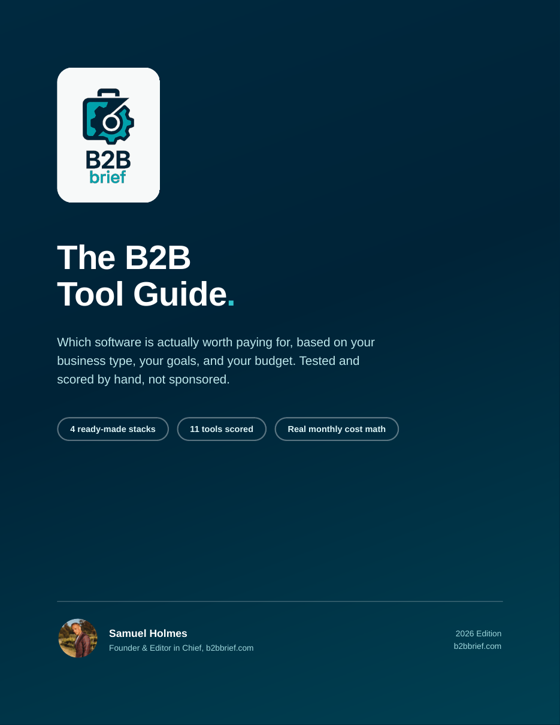
Get the Free B2Bbrief Tool Guide
The exact tools 500+ consultants use to run their business. Free PDF, no spam.
Instant download · No spam · Unsubscribe any time